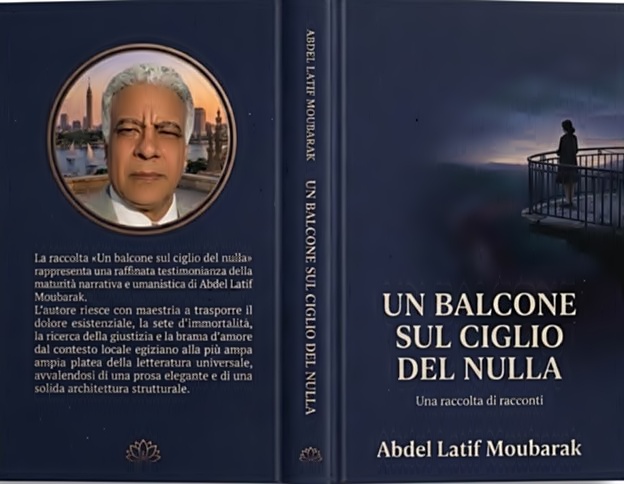
A Balcony on the Brink of Nothingness
The Eternal Moods of Existence in the Work of Abdel Latif Moubarak
Great contemporary literature is recognized by its ability to transcend geographical and linguistic boundaries to touch the universal chords of the human condition. With the publication of the collection “A Balcony on the Brink of Nothingness”, the Egyptian writer and poet Abdel Latif Moubarak firmly and gracefully enters the international narrative scene, offering the reader a work of rare emotional and philosophical density.
Translated and presented in the Italian language, the collection gathers stories that vibrate with a sensitivity both ancient and modern at the same time. Each story unfolds as a ray of light cast upon the cracks of the soul, where pain is never an end in itself, but becomes the crucible in which human dignity is purified and finds redemption.
AUTHOR PROFILE: ABDEL LATIF MOUBARAK
Abdel Latif Moubarak has long been one of the clearest and most authoritative voices in the contemporary Arab literary landscape. His work, historically linked to poetry and lyrics of deep social and metaphysical introspection, finds a new and exciting expressive maturity in this collection of short stories.
Moubarak’s pen never abandons its poetic roots: even in the rawest and most realistic narrative prose, one senses a musical rhythm, a meticulous attention to the choice of words, and a figurative elegance that transforms every description into a scene dense with pathos. The author demonstrates a profound knowledge of human nature, moving with extreme ease between Egyptian cultural tradition and the great dramas of the contemporary world.
GENESIS AND TITLE: THE BALCONY AS AN EXISTENTIAL METAPHOR
The title “A Balcony on the Brink of Nothingness” represents a textual threshold of extraordinary symbolic weight. The “balcony” is a place of observation, suspension, and temporary detachment from the frenzy of the world; it is a space on the border between the inside (the interiority of being) and the outside (tangible reality).
To be “on the brink of nothingness” means placing the characters of the work in boundary moments—situations of existential emergency where daily certainties collapse, leaving room for the abyss of the great questions: What remains of us after loss? How do we survive war, injustice, and the inexorable passage of time? Moubarak’s answer never falls into nihilism; the “nothingness” is not a destructive void, but rather a blank canvas upon which humanity is called to redraw the meaning of its own life.
A JOURNEY THROUGH THE STORIES: THEMATIC AND CRITICAL ANALYSIS
Remnants of Marble: Pain, Matter, and the Catharsis of Art
In this emblematic story, we meet Assem, a talented sculptor paralyzed by grief over the sudden passing of his wife, Sarah. For months, his tools remain covered in the dust of solitude, until he decides to face his mourning the only way he knows how: by carving a block of white Carrara marble.
The narrative follows the metamorphosis of the rigid, cold stone into a figure vibrating with lived life. Every blow of the chisel is an act of rage and love; the white dust enveloping the sculptor transforms him into a living artwork in dialogue with dead matter. However, the dramatic climax is reached when Assem understands the limits of art: the statue, however perfect and translucent, will not resurrect the real Sarah. With a gesture of serene acceptance, he donates the work to the city museum, declaring:
”This is not a statue… this is the last gasp of pain, and the first step toward life.”
The Chests of Pain: Rural Memory, Cyclic Time, and Roots
Under the sun of the Egyptian countryside, the elderly Hajja Amna sits near the old Saqiya (water wheel). The monotonous rhythm of creaking wood is not merely a mechanical sound, but the heartbeat of her memory. The friction of the wood draws memories from the past to pour them into a present parched by the absence of her children, who emigrated to the concrete of the metropolis.
The “Chest of Pain” that Amna guards contains no valuables, but rather the fragments of an existence built on hard work, lost affections, and peasant dignity. Moubarak delicately paints the inevitable conflict between alienating modernity and the ancient wisdom of the land, where even Amna’s death transforms into a cosmic embrace in which the wheel continues to turn, driven by the breeze of memory.
The Echo of Silk Bandages: Pharaonic Myth and the Immortal Transit of Love
Moving to the Theban Necropolis in Luxor, the story takes on the fairytale-like and evocative tones of myth. The soul (“Ba”) of the nobleman Amun-Mes awakens from his sarcophagus to search for his beloved Nefert. Crossing the Nile and descending into contemporary Luxor, the ancient Egyptian encounters Salma, a young archaeology student who possesses the same gaze and essence of his lost queen.
The dialogue between the ancient nobleman and the modern girl shatters the barriers of chronological time. The gift of the lapis lazuli scarab becomes tangible proof that true love is never buried by history, but merely waits beneath the sand for the right heart to call it home.
The Keeper of the Stars and Mud: War, Childhood, and Paternal Duty
With a sharp shift in setting, Moubarak transports us to Kyiv, amid the freezing Ukrainian winter and the roar of bombardments. Andriy, a sergeant in the defense forces and a new father to Yana following his wife’s death from illness, must reconcile two titanic duties: to be a shield for his homeland and the sole refuge of hope for his little girl.
The narrative builds a powerful visual and conceptual contrast: hands skilled in assembling a Kalashnikov rifle tremble while trying to braid his daughter’s hair; the sound of air-raid sirens collides with the innocence of a woolen teddy bear. The rifle loses its status as an instrument of death and becomes the “door lock” to prevent evil from shattering children’s dreams.
A Scale of Straw: Moral Corruption and Celestial Justice
This story constitutes a raw and unsparing social and ethical critique. Judge Adil Al-Rifai, accustomed to manipulating legal codes in favor of the powerful, agrees to exonerate the wealthy industrialist Sabri Bey for the deaths of twelve workers in an arson fire, shifting the blame onto an innocent young engineer named Amin.
Moubarak masterfully analyzes the psychology of power and the illusion of impunity. While sentencing the innocent man to life imprisonment seems to seal the triumph of injustice, the crack in the judge’s conscience manifests through an uncontrollable tremor in his hands and the obsessive striking of the gavel, reminding him of the young man’s promise: “We will meet before the Celestial Judge.”
A Silent Roar of Stone: Cairo’s Magical Realism
The final story is a gem of magical realism steeped in folk irony and deep melancholy. At three in the morning, the Sphinx awakens from its millennial slumber, shakes off the dust of centuries, and walks toward the crowded, chaotic streets of modern Cairo.
The contrast between the imposing majesty of the monument and the daily life of working-class neighborhoods like Sayeda Zeinab is portrayed with extraordinary vividness. People do not run away in fear; instead, they welcome the stone giant with typical Egyptian irony and generosity: young people take selfies, and a coffee shop owner offers a barrel of piping hot tea. The dialogue between the Sphinx and the inhabitants exposes the poverty and resilience of a people who inherited the patience of the Pharaohs to survive the harshness of the present.
STYLISTIC FEATURES AND NARRATIVE ARCHITECTURE
The narrative architecture of “A Balcony on the Brink of Nothingness” is distinguished by a series of precise stylistic choices:
Economy of Language: Moubarak avoids all redundancy; every word carries a specific weight, carefully calibrated with poetic care.
Narrative Polyphony: The stories adopt different points of view, allowing the reader to empathize equally with the sculptor’s pain, the soldier’s determination, or the elderly peasant woman’s drama.
Use of Continuous Metaphor: Inanimate objects (the marble, the water wheel, the scarab, the teddy bear, the rifle, the Sphinx) cease to be simple scenic elements and become true symbolic co-protagonists.
THE GEOGRAPHICAL AND HUMAN DIMENSION
One of the most fascinating aspects of the collection is the breadth of its geographical scope. Moubarak demonstrates that pain, love, and the pursuit of justice have no homeland.
From the banks of the Nile to the streets of Cairo, from the Egyptian countryside to the snow-covered trenches of Eastern Europe in Kyiv, the work composes a true geographical map of human emotions. This ability to transition between different cultures without losing narrative authenticity makes the collection a work of genuinely universal value.
LITERARY IMPACT AND INTERNATIONAL RECEPTION
The publication of “A Balcony on the Brink of Nothingness” within the Italian-language publishing context represents a cultural bridge of fundamental importance. In an era characterized by fragmentation and the speed of digital consumption, Moubarak’s work invites slowness, meditation, and empathy.
Critics welcome the work as a testimony of the highest value, capable of uniting the metaphorical richness of the Arab tradition with the essentiality and clarity of contemporary Western narrative.
VIRTUAL INTERVIEW WITH THE WORK: THE GREAT QUESTIONS
If we could question the work itself about its ultimate intentions, the answers would emerge clearly between the lines of every story:
Question: Can art defeat death?
Answer of the collection: Art does not resurrect the flesh, but it purifies memory and allows the living to take the first step toward a new life.
Question: What is the boundary between justice and injustice?
Answer of the collection: Human laws can be manipulated, but true justice resides in the incorruptible tribunal of conscience.
Question: What saves humanity in moments of absolute darkness?
Answer of the collection: The capacity to love, to protect the innocence of the weak, and to remain faithful to one’s roots.
CONCLUSION AND INVITATION TO READ
”A Balcony on the Brink of Nothingness” by Abdel Latif Moubarak is a work that leaves a profound mark on the reader. It is a read that moves, provokes thought, and enriches the soul.
We invite all lovers of great literature, poetry in prose, and authentic human stories to cross the threshold of this “balcony,” stepping out alongside the author onto that edge from which one can glimpse not the void of nothingness, but the dazzling light of hope and human dignity.
Book Details:
Title: A Balcony on the Brink of Nothingness (Un balcone sul ciglio del nulla)
Author: Abdel Latif Moubarak
Genre: Short Story Collection / Contemporary Narrative
Recommended for: Lovers of international literature, enthusiasts of prose poetry, and readers in search of stories with high emotional and philosophical impact.